
How to Reset Your Life in 7 Days Using the Keys to Succeeding
Discover a practical 7-day plan to reset your life using the 5 Keys to Succeeding framework. Transform your mindset, habits, and vision with daily actionable steps for lasting change.
Anthony Carter
11/23/202515 min read


How to Reset Your Life in 7 Days Using the Keys to Succeeding
Feeling stuck—going through the same routines day after day—makes you know deep down you want more from life. What if you could intentionally press pause and reset your life in 7 days to build momentum toward a clearer vision future? This plan isn’t about flipping your world overnight; it’s a focused seven-day challenge of small, strategic steps that free up time, clear mental clutter, and create real progress.
Using the simple, practical "5 Keys to Succeeding"—Clarity, Action, Adjust, Persist, Repeat—you’ll get one concrete step each day that moves you closer to the life you want. By the end of one week you’ll have clearer priorities, a morning and evening routine you can follow, and the first actions scheduled to start making a difference. If you’re ready to get clear about what matters and want start building momentum right now, this is the way to do it.
Ready to Transform Your Life?
Grab the free "5 Keys to Succeeding Daily Checklist"—a simple list you can use every morning and evening to track the small things that add up each day. It shows the exact habits, minutes, and prompts to focus on so you make measurable progress during this one week reset.
Download Your Free Checklist
Your 7-Day Life Reset Plan: An Overview
Before you dive into the daily actions, here’s a clear map for this one week challenge: each day focuses on one practical area so you make steady progress without burning out. Spend about 15–45 minutes each morning or evening on the tasks and use the checklist to track what you complete—small consistent actions add up over life days into real change.
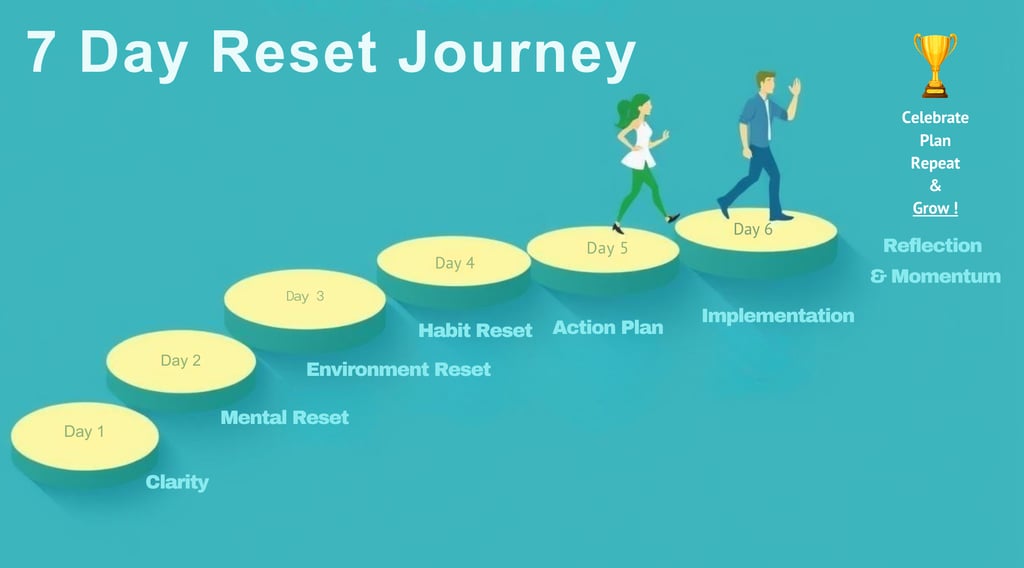
The 7-Day Reset Journey: From Feeling Stuck to Transformation
The 7-Day Reset at a Glance:
Day 1: Clarity – Outcome: Get clear on priorities and pick 2–3 focus areas to change this week.
Day 2: Mental Reset – Outcome: Clear mental clutter, surface limiting thoughts, and create empowering alternatives.
Day 3: Environment Reset – Outcome: Make space in one primary area (physical or digital) so it supports your new habits.
Day 4: Habit Reset – Outcome: Design simple morning and evening routines and identify keystone habits to practice daily.
Day 5: Action Plan – Outcome: Break each vision into small milestones and schedule the first steps into your calendar.
Day 6: Implementation – Outcome: Do the first tiny actions, eliminate top distractions, and record what worked.
Day 7: Reflection & Momentum – Outcome: Celebrate wins, plan next week, and set a weekly practice to repeat and grow.
Use the checklist as a simple list to guide your morning and evening practice: check off habits, note the minutes you spend, and capture one insight or idea each day. This plan isn’t a one-size-fits-all prescription—adjust the steps to fit your work, friends, and schedule so the reset becomes a sustainable way forward you can repeat after this one week.
Day 1: Clarity – Assess Your Current Reality and Define Your Vision
The first key to succeeding is Clarity, and that's where we begin. Before you can move forward, you need a clear picture of where you are now—honest, simple, and actionable. Think of this as your starting map for the week: a practical snapshot that helps you get clear about priorities and the changes you want to make over the coming days.
Your Day 1 Tasks:
Life Assessment – On a sheet of paper or in your journal, rate your satisfaction (1–10) in eight areas: Career, Finances, Health, Relationships, Personal Growth, Environment, Recreation, and Spirituality/Purpose. Example: Career 6, Health 5, Relationships 7.
Identify Priority Areas – Circle the 2–3 lowest scores. These are the focus areas for this reset—the ones where small steps will create the biggest difference in your life days ahead.
Vision Creation – For each priority, write one clear vision statement of success. Make it concrete and emotionally vivid. Example: “In 30 days I have energy to work out three mornings a week and feel confident in my body.”
Your "Why" – Under each vision, write a short sentence about why this change matters to you. This anchors motivation when things get challenging and helps your mind prioritize the right actions.
"Clarity comes from engagement, not thought."
When you take the time to honestly assess where you are and clearly define where you want to go, you create the foundation for all meaningful change.
— Key to Succeeding #1: Clarity
Clarity Exercise: Future Self Visualization
Set aside 10 minutes in a quiet spot—morning or evening works. Close your eyes and imagine your ideal future 30 days from now. Prompt yourself with three questions: What do you see? How do you feel physically and mentally? What one routine or thing is different every day? After the visualization, write down everything you noticed on paper; don’t edit—capture thoughts and details.
This short practice helps your mind link feelings to concrete images, making the vision future more real and actionable. Use the visualization output to refine your vision statements and to create one sentence you can read each morning to get clear on your day’s purpose.
If you want a ready-made template, the downloadable checklist includes a Life Assessment table and the exact prompts to use for this exercise—so you can quickly score, pick priorities, and move on to Day 2 without getting stuck in perfectionism.
Day 2: Mental Reset – Clear Mental Clutter and Limiting Beliefs
Day 2 is about making mental room for new possibilities. Think of your mind like a phone with too many apps open—when you clear background noise, the important things run smoother. Today’s practical steps create space so your vision can start to feel achievable rather than overwhelming.
Your Day 2 Tasks:
Morning Brain Dump – Spend 10 minutes with a pen and paper. Use three quick headings: Worries, To-dos, Random Ideas. Write without editing. Getting things out of your head frees up mental bandwidth for the rest of the day.
Identify Limiting Beliefs – Look at your Day 1 assessment and the brain dump. Note two common negative thoughts (for example: "I’m not disciplined" or "I’ll never change").
Create Empowering Alternatives – For each limiting belief write an empowering replacement. Example: replace "I’m not disciplined" with "I’m building discipline with small, consistent steps." Keep these short and post them where you’ll see them the first thing in the morning.
10-Minute Mental Clearing – Practice a simple guided script: sit quietly, focus on the breath for two minutes, scan your body for tension for three minutes, then observe thoughts for five minutes without following them—just notice and label ("thinking," "planning," "worrying").
Mental Reset Technique: The 4-7-8 Breath
The 4-7-8 breathing technique (popularized by Dr. Andrew Weil) is a fast way to calm the nervous system when thoughts pile up:
Inhale quietly through your nose for 4 seconds
Hold your breath for 7 seconds
Exhale fully through your mouth for 8 seconds
Repeat 3–4 times as needed
Breathwork and short mindfulness practices are supported by many studies showing reductions in stress and improved focus (see mindfulness research summaries for details).
Remember: the quality of your life often tracks with the quality of your thoughts. Use the morning brain-dump as a daily practice and save the prompts in your checklist so you can repeat this step in future days. If you like a reading book for mindset work, choose one that gives short, practical exercises you can apply in minutes each day.
Day 3: Environment Reset – Transform Your Physical Space
Your external environment reflects your internal state—and it can work for you or against you. Today we focus on designing physical and digital spaces that support your vision future and make the right habits the easy choice. This is an Action day: small changes in your surroundings will save time and reduce friction for the routines you want to keep.
Your environment shapes your mindset and behavior
Your Day 3 Tasks:
Identify Your Primary Spaces – List the 2–3 places where you spend most of your time (home office, bedroom, living area). Note one thing in each space that either supports or distracts from your goals.
One-Hour Declutter – Pick ONE space and spend exactly one hour using this quick checklist: Sort (keep/toss/donate), Remove trash, Put things you need in a “keep” pile, Place donated items in a box, Wipe surfaces and reset. Work in 15-minute mini-sprints to stay focused.
Create a Reset Zone – Designate a small corner as your reset zone for morning and evening practice: keep a journal, a glass of water, and one prompt card. Even a single shelf or corner will cue your new routines every day.
Digital Declutter – Triage your phone and inbox: delete unused apps from your home screen, unsubscribe from lists you don’t need, silence nonessential notifications. The goal is fewer distractions when you need deep focus.
"Environment is stronger than willpower. Design your surroundings to make the right actions easy and the wrong actions hard."
— Key to Succeeding #2: Action
The Power of Environmental Triggers
Your brain links places and objects to behaviors. Use that to your advantage with three example triggers:
Work: Place a clean notebook and a pen on your desk so starting a focused session is the first thing you see.
Exercise: Put workout clothes and shoes next to your bed or by the door to prompt a morning movement habit.
Sleep/Recovery: Remove screens from the bedroom and keep a bedside water glass and a short reading book to signal wind-down time.
These are practical, not perfect—don’t chase a magazine-ready room. The point is to make good choices the path of least resistance by arranging a few obvious cues. As you declutter, use a single sheet of paper to list "things need" and "things to get rid of" so decisions happen quickly and you avoid overthinking.
Maximize Your 7-Day Reset
Download the free checklist for a printable one-hour declutter checklist and a reset-zone setup guide—simple templates that save you time and help you implement these steps immediately.
Download Your Free Checklist
Day 4: Habit Reset – Design Your Cornerstone Daily Habits
Now that you've cleared mental and physical clutter, Day 4 is about building practical routines that stick. This Adjust day focuses on tiny, repeatable practices that support your vision and give your life structure without stealing your time. The goal: pick a few keystone habits you can do first thing each morning or before bed so progress compounds across days and weeks.
Your Day 4 Tasks:
Identify Keystone Habits – From your Day 1 priorities, choose ONE tiny daily habit per area that delivers the biggest impact. Keep it microscopic: reading one page, two minutes of movement, one quick call. The smaller the step, the more likely you are to do it every day.
Design Your Morning Reset – Build a 15–30 minute sequence for body, mind, spirit. Sample template: 3 minutes gentle stretch (body), 10 minutes journaling (thoughts + priorities), 5 minutes visualization (vision). Make this your “first thing” routine.
Design Your Evening Reset – Create a 15–20 minute wind-down: 5 minutes gratitude or wins, 5–10 minutes review and plan for tomorrow, and a brief breathing practice to sleep better. This closes the day and primes tomorrow’s morning routine.
Habit Stacking – Attach new habits to established ones. Example: after you brew your morning coffee (existing), read one page of a book (new). Stack small steps so they feel effortless and become automatic over time.
The 2-Minute Rule
Start so small it’s ridiculous. Want to read more? Read one page. Want to move more? Do two minutes of movement. These tiny actions reduce resistance and build the consistency you need to scale later.
Habit Tracking
Track what you do. A simple tracker: columns for Date, Habit, Minutes, Done (✓), Note. Sample entry: 04/10 • Read (1 page) • 5 min • ✓ • "felt focused." Tracking turns vague intentions into measurable progress.
"Small habits don't add up; they compound. Tiny changes in daily routines might seem insignificant at first, but they deliver extraordinary results over time."
— Key to Succeeding #3: Adjust
Remember: your habits should support your life and work, not become a new source of stress. Use the checklist to print a habit tracker and sample morning routine you can tweak. Start with the smallest version, practice it for a few days, then increase minutes or steps only when it feels natural. Over time these micro-practices change your body, your mind, and your day for the better.
Day 5: Action Plan – Create Your Strategic First Steps
With the foundation you've built across earlier days, Day 5 is where you convert vision into tangible, scheduled action. This Persist day helps you bridge the space between where you are and the life you want by breaking big ideas into tiny, doable steps you can actually fit into your week.
Your Day 5 Tasks:
Vision Breakdown – For each priority from Day 1, list 3–5 milestone achievements that show progress. Example (career): Update resume, reach out to 3 network contacts, apply to 2 targeted roles.
First Action Steps – For every milestone identify the smallest first step. Make it so tiny it's almost trivial—this removes excuses. Example: open your resume file for 5 minutes and add one line.
Weekly Planning – Block specific times this week for those first steps. Put them in your calendar as non-negotiable appointments—15–30 minute slots that respect your existing commitments and energy.
Obstacle Planning – For each step write an If-Then backup. Example: "If I’m too tired after work, then I’ll do a 10-minute version instead of skipping." This keeps momentum even when things don’t go perfectly.
The 20-Minute Rule
When resistance shows up, try the 20-minute rule: commit to focused work for just 20 minutes. Often starting is the hard part—once you begin, momentum and clarity make it easier to continue. If you stop after 20 minutes, you still moved the needle.
Action-Plan Template (Use this now)
Milestone → First Step → Scheduled Time → Obstacle (If-Then)
Career example: Research companies → Find 3 roles to target → Tue 7 pm–7:30 pm → If tired, do 15 min instead.
Health example: Build cardio consistency → Put on workout clothes and walk 10 minutes → Morning 6:30 am → If rain, do 10-min indoor routine.
Creating Accountability
Accountability increases success. Research on goal-setting and social support shows sharing progress raises follow-through—choose what fits you:
Public Commitment
Tell a friend or post a quick update to someone who will cheer you on and check in. Public promises raise the stakes and keep you honest.
Private Commitment
If you prefer privacy, write a short contract with yourself: sign it, put it on paper, and review it daily. This internal pact can be powerful when paired with consistent habit practice.
"Persistence isn't about never failing; it's about getting back up one more time than you fall. Plan for imperfection and you'll build resilience."
— Key to Succeeding #4: Persist
Use the downloadable checklist to grab a fillable action-plan page and a short weekly challenge schedule you can copy each week. These small, scheduled steps are the way to move thoughts into real-world progress—one manageable step at a time during this week and beyond.
Day 6: Implementation – Take Decisive Action
Day 6 is where planning becomes practice. After the vision, habits, and first steps you designed earlier in the week, today you focus on doing — deliberately, for short focused bursts — so you build momentum that carries into the days ahead. Small wins today compound into meaningful life change over time.
Your Day 6 Tasks:
Morning Intention Setting – Start with your morning routine, then set one clear intention for the day: the most important thing you want to move forward. Say it out loud or write it down so your mind stays focused.
First Step Implementation – Execute the tiny first steps you scheduled on Day 5 for each priority. Remember: these steps are deliberately small so they're almost impossible to avoid.
Distraction Elimination – Identify the top 3 things that pull your attention (phone, email, open tabs). Use simple tactics: turn off notifications, enable Do Not Disturb, or open a single full-screen document to block visual clutter while you work.
Progress Documentation – End the day with a short log: What I did (one line per priority), What I learned (one sentence), Next small step (one thing). This creates clarity for tomorrow and captures momentum.
The Power of Starting
Action beats perfect plans. Commit to the smallest step and begin — often the act of starting generates the energy to continue. That initial movement turns vague intentions into tangible progress.
Celebrating Small Wins
Recognize each completed action. Celebrating small wins (a nod, a brief note in your journal) reinforces the behavior and motivates you to repeat it. The reward feedback loop helps your mind associate effort with positive outcomes.
"Action creates clarity. When you're unsure of the perfect path forward, the best solution is often to take the smallest possible step and let the next step reveal itself."
Implementation Technique: Time Blocking
Use time blocks to protect real work: schedule 15–30 minute sessions for each priority. Sample day with two focused blocks:
Option A: 9:00–9:25 Focus Block (priority A), 9:25–9:30 Quick review, 2:00–2:25 Focus Block (priority B), 5:00–5:10 Progress log.
Option B: 7:00–7:30 Morning routine + 7:30–7:50 First-step work, 12:30–12:50 Short block for follow-up, 8:30–8:40 Evening review.
If you prefer tools, use a simple timer (Pomodoro apps, or the built-in phone timer) and a distraction blocker for your browser during focus blocks. At the end of the day, complete your progress template: What I did / What I learned / Next step — it takes a few minutes and keeps your momentum intact.
Perfect implementation isn't the goal—consistent action is. If you miss a block or a planned thing, note why, adjust, and recommit. Persistence over days is the most reliable way to move your vision forward.
Day 7: Reflection & Momentum – Celebrate Progress and Sustain Change
The final day of your reset is about closing the loop: reflect on what you accomplished, celebrate the wins, and put simple systems in place so the changes continue after this week. This Repeat day turns short-term progress into a repeatable practice that keeps momentum moving forward one day at a time.
Your Day 7 Tasks:
Week Review – Spend 15–20 minutes answering three review prompts: What worked? What was surprisingly hard? What did I learn about myself? Capture short bullets so you can spot patterns across life days.
Progress Celebration – Identify and celebrate at least three specific wins (no win is too small). Examples: completed a morning routine three times this week; cleared a reset zone; scheduled first action steps. Celebrate with a small ritual—tell a friend, take a walk, or mark it in your journal.
Next Week Planning – Use three planning slots: pick the top habits to continue, schedule two action steps, and set one measurable goal for next week. Keep the plan short so it’s easy to follow during busy days.
Sustainability Check – Review each new habit and ask: Is this realistic long-term? If not, what small adjustment makes it stick? Swap out or shrink any habit that feels like a chore—sustainability beats perfection.
The Weekly Reset Ritual
Choose one short ritual—Sunday evening or Monday morning—that you repeat each week: a 20–30 minute session to review last week, celebrate wins, and plan the next seven days. This habit turns reflection into progress and prevents slipping back into old routines.
The Power of Compounding Change
The real value of this 7-day reset shows up over time. Small, consistent actions taken across days and weeks compound into meaningful results: more energy, clearer focus, better habits, and measurable progress toward your vision. Think of today as planting seeds—the ones you water each week are the ones that grow.
"The fifth key—Repeat—is what transforms a temporary reset into a permanent upgrade. Systems outlast motivation. Build systems that make your new behaviors automatic."
— Key to Succeeding #5: Repeat
Before you finish today, fill in this simple weekly-reset template: Review (3 bullets), Wins (3 items), Next Week (3 actions), One adjustment to make habits sustainable. Put it on paper, set a reminder for next week’s ritual, and consider signing up for a weekly prompt email or sharing your progress with friends to keep accountability alive. Small, habitual steps are the things that change lives—one consistent minute at a time.
Frequently Asked Questions About the 7-Day Life Reset
Can I really reset my life in just 7 days?
Short answer: you can create powerful momentum in seven days, but lasting transformation takes ongoing effort. In one week you can clear mental and physical clutter, establish new micro-habits, and schedule the first action steps that move you toward the life you want.
Think of this week as a focused launch: a concentrated period to get clear, take small consistent steps, and build a repeatable practice. Use the checklist as your daily list and prompts to keep minutes and tasks measurable so progress continues after the initial one week.
What if I miss a day or can't complete all the tasks?
Progress beats perfection. If you miss a day, acknowledge it, then pick up where you left off—the important part is repeating the practice over days, not executing every task perfectly. Missing a day is an opportunity to practice Adjust: tweak the plan so it fits your real life.
If time is tight, scale the tasks down (use the 2-minute or 20-minute rules) or spread them across the day in short blocks. The downloadable checklist includes abbreviated prompts and an hourly-friendly version so people with busy schedules can still participate.
How do I maintain my progress after the 7 days?
Maintain momentum by turning actions into systems. Key tactics include:
Continuing short morning and evening routines (even 10–15 minutes)
Using a weekly reset ritual (20–30 minutes) to review progress and plan
Habit stacking to attach new behavior to existing routines
Creating environmental triggers that cue your desired actions
Setting up accountability with friends or a simple tracking list
Research on accountability and goal-setting shows that sharing goals or tracking progress increases follow-through (see goal-setting research summaries). The "5 Keys to Succeeding Daily Checklist" is designed as a portable tool to track those elements and prompt weekly reflection so small progress compounds over life days.
Can I adapt this plan if I have limited time or special circumstances?
Yes. Treat every task as flexible: reduce minutes, combine steps, or split actions across your day. The framework is intentionally modular—if you have physical limits, chronic conditions, or family responsibilities, choose micro-steps that respect your energy and still move you forward.
If helpful, download the checklist’s “short-form” plan (included) that fits into a single hour or can be completed in scattered 10–15 minute slots throughout the day.
The 5 Keys to Succeeding: A Framework for Lasting Change
Your New Beginning Starts Now
Seven days ago you might have felt stuck, moving through routines without a clear direction. After this focused one week challenge, you’ve built a practical foundation for meaningful change: clearer priorities, a few repeatable routines, and the first small actions scheduled to move toward the life you want. Those tiny steps are the difference between wishing and actually making progress.
This is not a one-time fix but a way of working on your life that compounds over time. By applying the 5 Keys to Succeeding—Clarity, Action, Adjust, Persist, Repeat—you’ve created a repeatable routine that supports steady growth. Keep treating each day as an opportunity to add another small, deliberate action toward your ideal future.
Transformation isn’t always linear; you’ll face setbacks. When that happens, use the Adjust key: shrink a habit, move a block, or swap a task so you keep momentum. The goal is consistent progress across life days, not perfection in any single day.
Right now, take one concrete next step: open a blank page and write one sentence that captures the single most important thing you want to move forward this week. Make it specific—this one sentence becomes your morning prompt for the next day and keeps your vision future in focus.
Continue Your Transformation Journey
Download the free "5 Keys to Succeeding Daily Checklist" to turn today’s gains into ongoing progress. The checklist gives a simple morning prompt, a short evening review, and a one-page plan you can use tomorrow morning to start your day with clarity.
Get Your Free Checklist Now
Keys To Succeeding
Unlock your potential with expert-backed advice today.
Growth
Inspiration
contact@keystosucceeding.com
© 2025 keystosucceeding.com All rights reserved.
motivation
insights
prIVACY policy
Disclaimer: Some links on this site are affiliate links. This means I may earn a commission if you click through and make a purchase, at no extra cost to you. I only recommend products and services I trust and believe will add value.